From Loose Networks to Organised Collaboration: Reflections on the Green Screen Catalyst Fund and Next Steps
We’re two years after the kickoff of the Green Screen Catalyst Fund—an offering that resulted from several years of …
launch
Published on
launch
Authors: Green Screen Coalition
Over the course of the last year and a half, the Green Screen Coalition has supported 22 individuals, collectives and organisations working at the nexus of climate and environmental justice and digital rights through the Catalyst Fund. The work reflects over 4 years of field building, convening and collective work supported by a wider coalition, advisory board and network.
To learn more about the diverse global network, dive into the project summaries below–organised under four categories Tech Innovation, Cultural Work & Media, Community Action Research and Legal and Policy Analysis. Two horizontal principles cut through these categories: strengthening communities and bridge-building. Taken together, the body of work reflects varying strategies, approaches and thematics that coalesce into a nuanced analysis of the intersection of climate, environmental and digital justice around the world.
Below is a summary of each project and the ways in which their impacts contribute to a stronger climate, environmental justice and digital rights field.

Photo of current prototype
Beyond Carbon is a prototype that unites multi-sensory community-owned information and scientific datasets about rainforests in Mekar Raya, a village in Indonesia’s West Kalimantan province. In May 2024, Cindy Julianty and Madhuri Karak recorded forest sounds (eco-acoustic); conducted interviews with Dayak elders recounting myths and changes they’ve witnessed in the rainforest across generations (oral history); asked community members to sing songs celebrating sacred places (acoustic); and compiled a repository of culturally significant local species in the Dayak language (text). In 2025, Julianty, Karak, and Michelle Cheripka coordinated a community review process of a three-screen video installation in Mekar Raya, designed to elicit responses outside of “NGO-speak” and partly to encourage “multi-sensory” ideas.
The prototype forged new partnerships, by engaging groups working in forest advocacy in Indonesia (Working Group of ICCAs in Indonesia and Tropenbos Indonesia), advocating for Indigenous and Local Communities seeking territorial recognition. This opened the door for integrating the multi-sensorial methodology as a novel tool for advocacy and broader paradigm shifts. The prototype was chosen in Spring 2025 to participate in the Ds-Discovery Program at the College of Computing, Data Science, and Society, University of California, Berkeley.
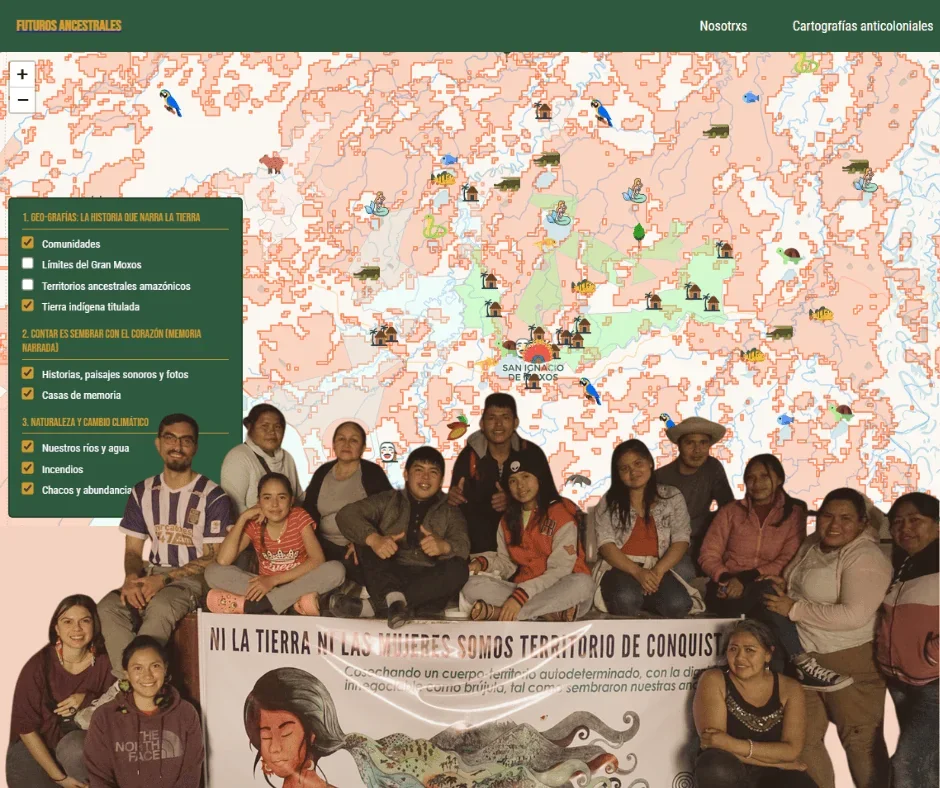
Photo of collaborators in front of digital map
Jasy Renyhê produced a data repository containing the results of 23 in-depth interviews with Indigenous leaders, territorial authorities, elders, and youth in Bolivia. Afterwards, they trained indigenous communities in data collection, and developed a portal storing the data documenting 19 burned areas in regions immediately adjacent to indigenous communities. The training reached 31 participants, all of whom took part in sessions on data gathering, participatory community mapping, QCIS and meetings coordination for the learning process. Together with territorial authorities, Jasy Renyhê established the data repository Futuros Ancestrales, hosted under the group’s website and domain.
The impacts touched many communities, from territorial monitors and authorities, Indigenous youth, elders and artisans. The workshops provided digital tools to articulate territorial struggles for land reclamation, historical justice, and Indigenous autonomy. By creating a digital platform owned and managed by participants, the project established a resource that can continue to grow on their own terms. Project members now have a space where they can access pedagogical materials, contribute new data, and develop additional strategies for territorial defense.
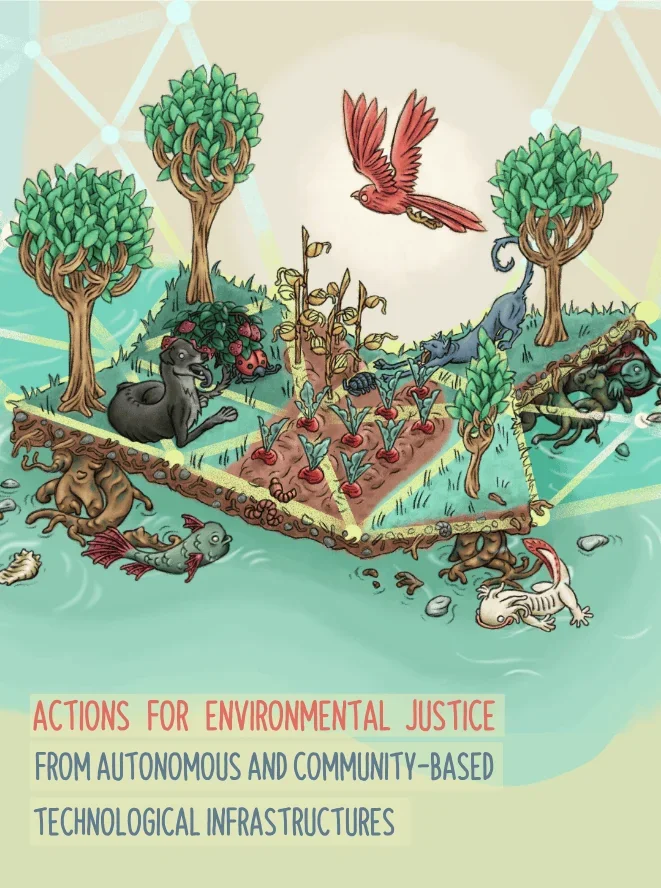
Cover of the Sursiendo and May First report
Sursiendo, along with May First Movement Technology, researched action strategies to embed environmental sustainability into autonomous internet communications infrastructure projects. Drawing on participatory methodology based on conversations with autonomous and community-based providers, they produced a report in English and in Spanish that documents current sustainable practices, key obstacles, future projections and speculative ideas toward environmental justice. Groups emphasize shared infrastructures, hardware longevity, free software, and collective approaches as a path forward. The report was documented through a recorded webinar, archiving a conversation with the participating organisations MariaLab (Brazil), Sutty (Argentina) and Cloud68 (Estonia).
The work highlights the importance of collaborative action and radical imagination to create technologies more committed to the protection of life. Their work shows that the most creative technical solutions will come from community providers who have a closer connection to the people they support and a vision for regenerative infrastructures that meet collective needs.
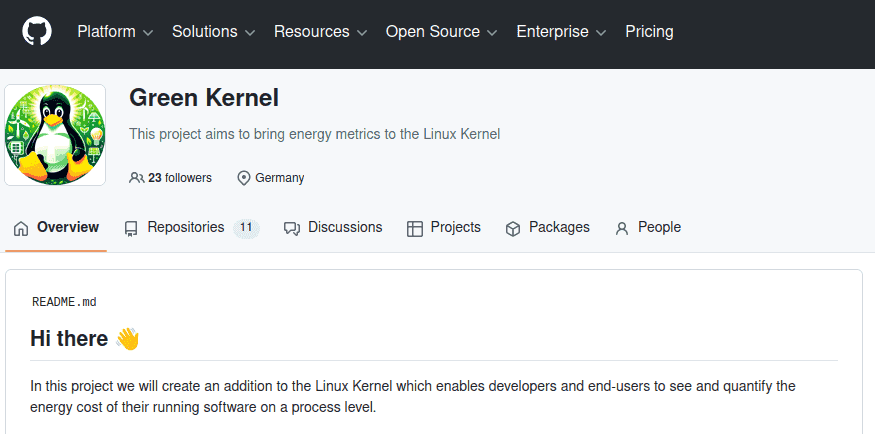
Green Kernal github
Green Coding developed Green Kernel, an addition to the Linux Kernel that enables developers and end-users to see and quantify the energy cost of their running software on a process level (cgroup). This technology is critical because it is a fundamental building block for creating and optimizing software with respect to energy consumption. As they developed the tool, they raised awareness among software developers, companies and open source communities about the need for visualizing the energy cost of software.
Their work in the open source community has led to future collaboration integrating the tool within NextCloud – a secure self-hosted cloud platform – as well as integrations with several universities. Conversations on energy use and tech infrastructure, like data centers, are booming and having concrete data and tooling to quantify use is an essential component to wider agendas in the network.
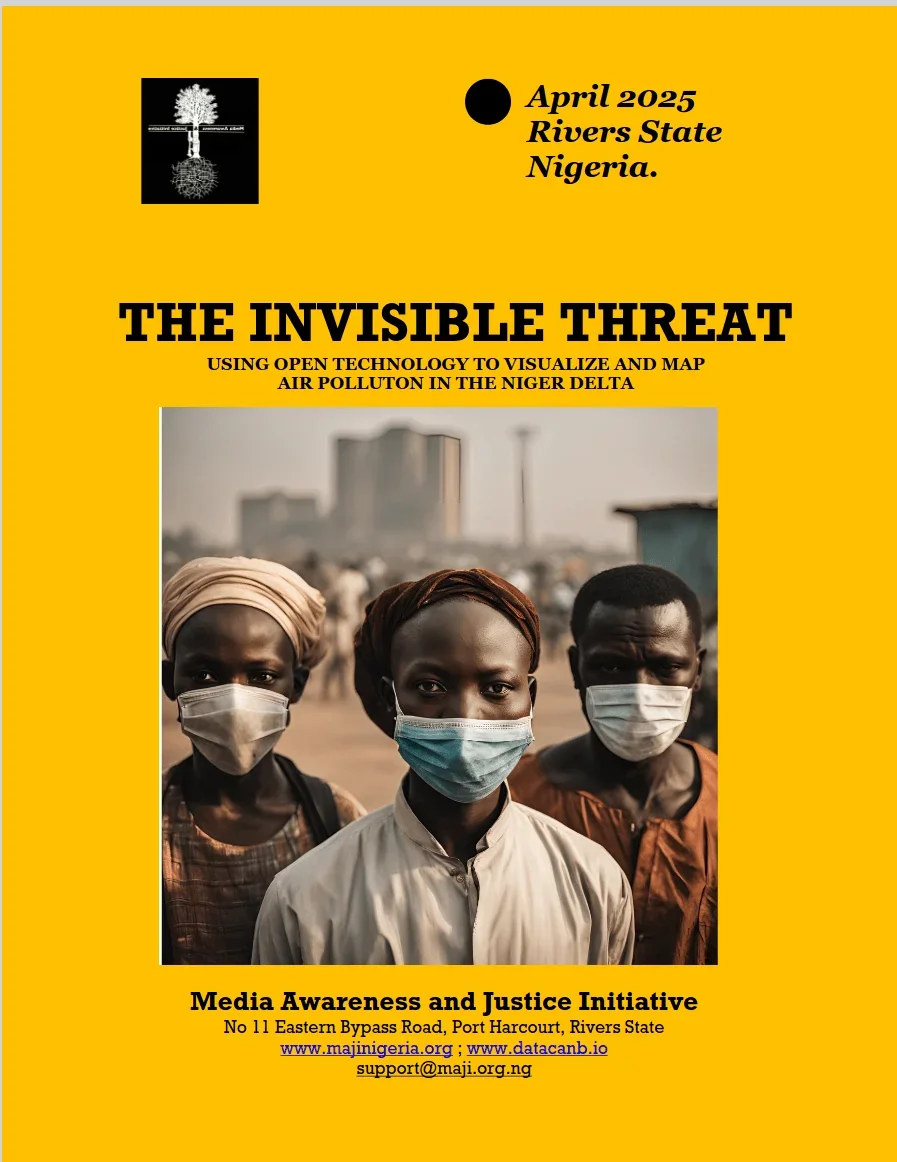
Cover of MAJI report
The Environmental Sensing Project deployed 60 low-cost single-board air and water quality sensors to collect real-time data on air and water pollution in crude oil-impacted locations in the Niger Delta region. The group produced the “Invisible Threat - Using open technology to visualise and map air pollution in the Niger Delta”, providing environmental factsheets and policy recommendations for advocacy and awareness raising. The project served as the basis for training journalists and community-based local actors, supporting their collection and use of environmental data for effective evidence-based campaigns.
The research centered on local experiences and MAJI built multi-stakeholder locally-rooted forums, and engaged local participants, community leaders, activists, and civil society organizations. This is a much needed approach as the impacts of climate change intensify across rural coastal communities and urban areas in Nigeria, and peoples living in these areas experience the harshest effects with huge impacts on their health and livelihood.
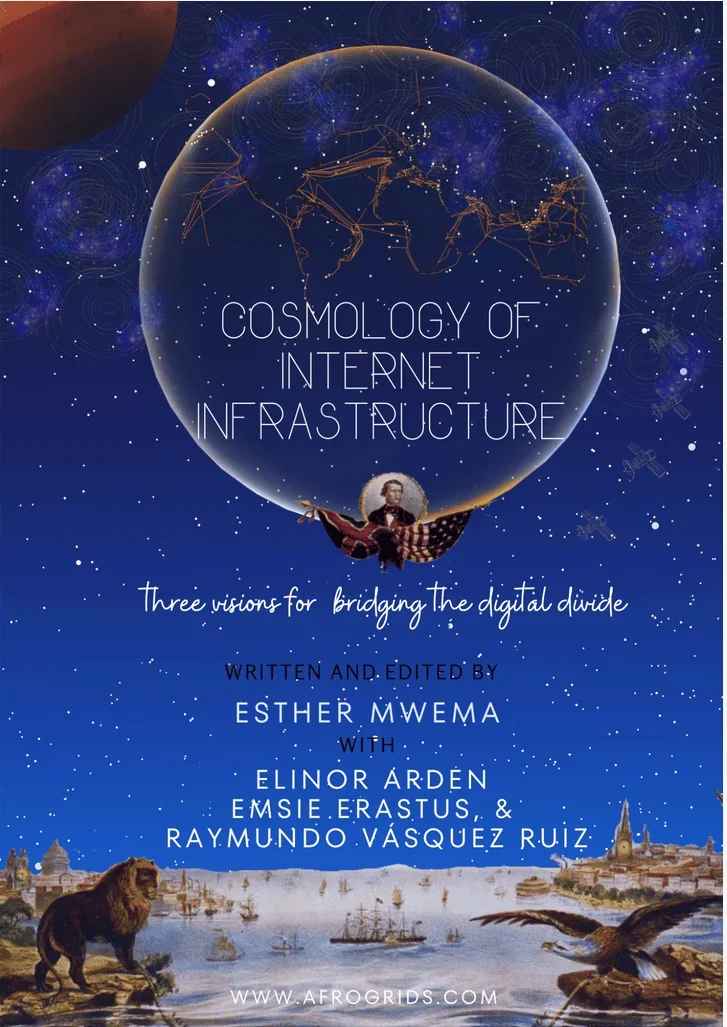
Cover of publication
Esther coordinated the publication ”Cosmology of Internet Infrastructure: Three Visions for Bridging the Digital Divide”. The publication includes her 3 artworks and a collection of essays that inspired them, articulated by multi-faceted practitioners Elinor Arden, Emsie Erastus, and Raymundo Vásquez Ruiz from Zambia, Namibia, Mexico and the USA. These visualised versions of the future simplify the concepts of internet infrastructure and show the relationship between it and the climate crisis.
Specifically, Esther analyzed the dilemma between increased internet infrastructure to bridge the digital divide and the extraction of resources in the African context. Her work provides accessible entry points on the topic of internet infrastructure and digital colonialism, using cosmologies as a way to explore folklore-rooted visions of future infrastructure. This visioning work challenges the inevitability narrative of extractive infrastructure and disrupts the current trajectory of digital colonialism in Africa and across the Majority World.
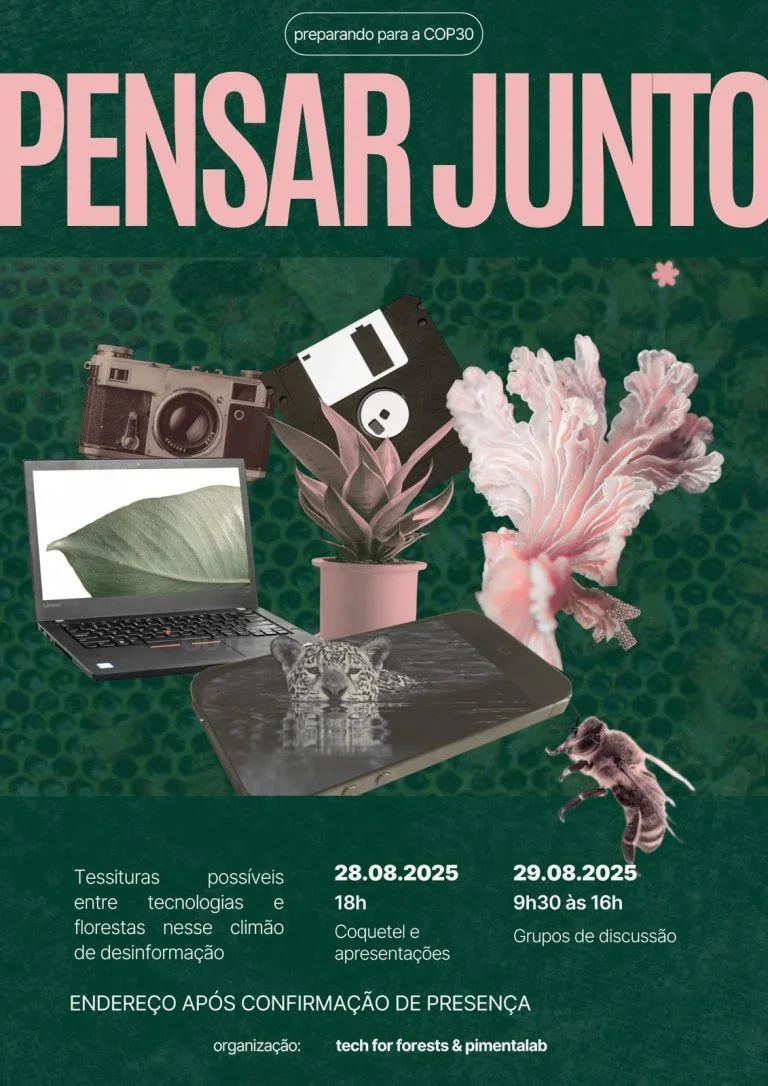
Event poster
Tech for Forests focused on core institutional strengthening, such as advancing its communications strategy, community building efforts and content production. Tech for Forests developed a new visual identity and website, produced 3 short films, and launched a call for submissions to the “Letters for 2050: Inspiring the future and reforesting technologies”, a visioning initiative. The collective was able to attend 3 strategic events in Brazil (Free Land Camp in 2024 and 2025 as well as Indigenous Women’s March in 2025), and convene together with the Federal University of Sao Paolo’s Pimentalab entitled “Thinking Together: Possible Connections between Technologies and Forests in this Climate of Disinformation” (2025).
Through the project, they engaged activists within indigenous communities, academics, and developers, fostering debates around COP30, proposing strategies for resistance and strengthening reliable and impactful narratives. Tech for Forests’ intergenerational work engages with established and emerging forms of media (film and VR) and uses speculative fiction as a tool for envisioning new technological futures.
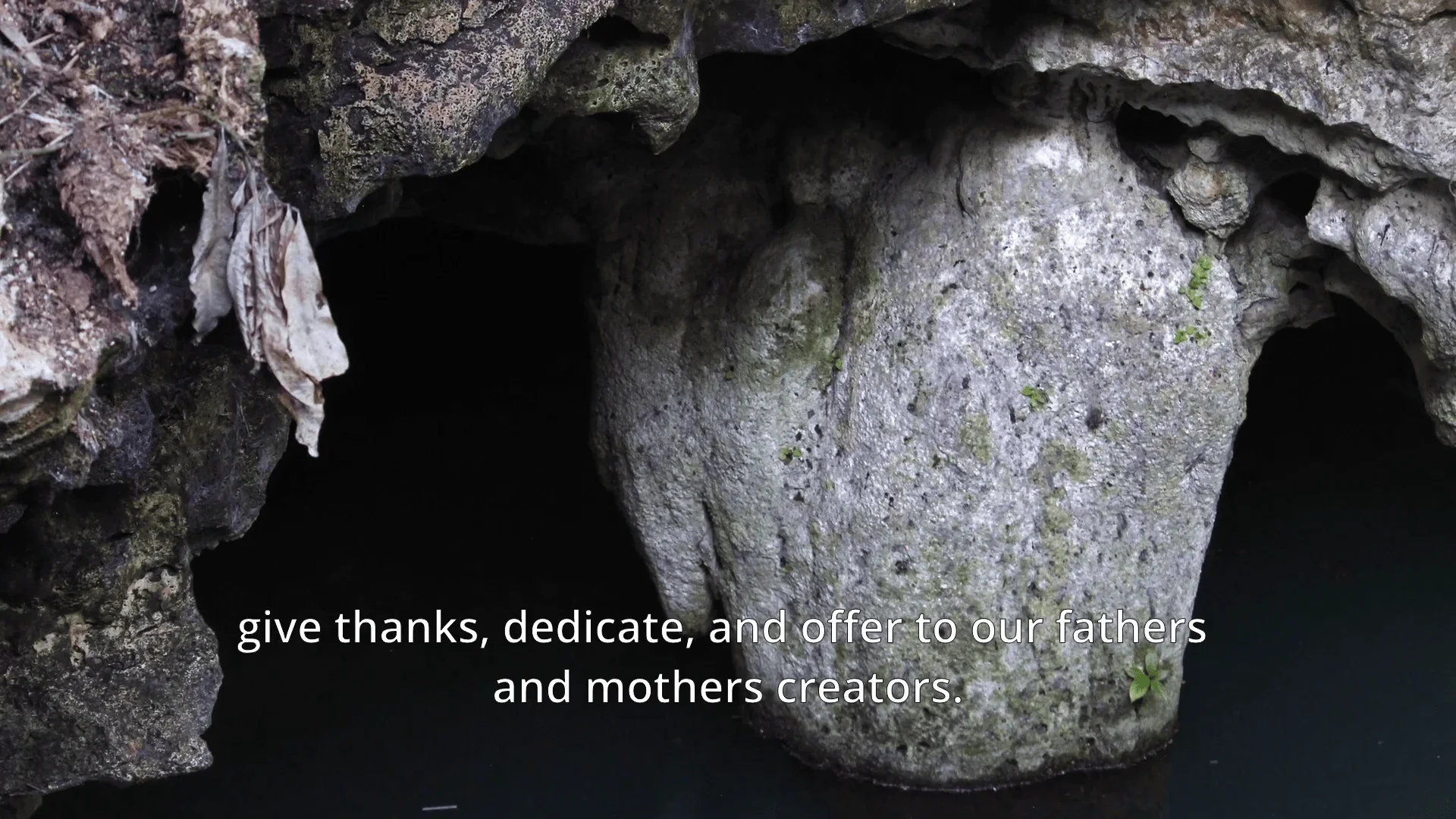
Still from JA’ film
Rub Solis Mecalco produced 2 short films in Yucatecan Maya and Spanish (with English subtitles) about the socio-ecological impacts of Megaprojects in the region, as well as local initiatives and alternative proposals against these impacts. The two films are titled “KOOL” (11min. 21sec., 2025) and “JA’” (9min. 44 sec., 2025). The films were projected in 3 rural Mayan communities and in a cultural space from a peripheral neighborhood in Merida, the biggest urban Mayan population in the region. They were also shown at RightsCon 2025 in Taiwan and in Berlin at a local queer community center.
The project brought an indigenous, feminine, non-binary and collective approach to the production of these films. Participating in every step of the creative process behind and in front of the cameras proved the power of being autonomous about representation, about the narratives and aesthetic proposals that Mayas want to share with other Mayan Communities and around the world. The film explores and expands beyond tech infrastructure, for example data centers, and includes powerful actors from industrial agriculture and renewable energy, documenting how they contribute to land dispossession, and environmental harms in the region.
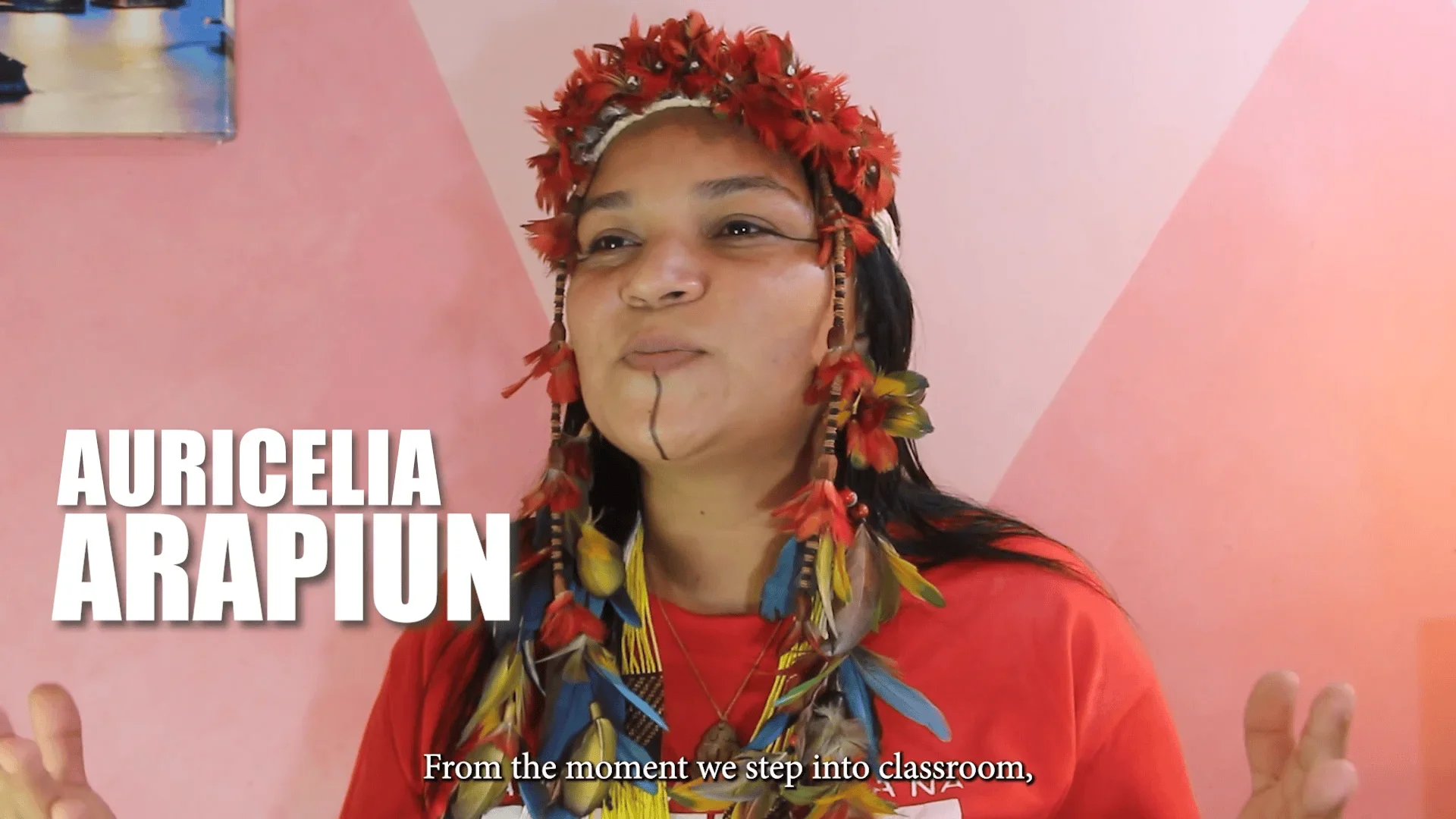
Still from Risk Factors film
Camila and her team were able to advance the work on the web documentary, Risk Factors. Risk Factors highlights the challenges faced by 5 women researchers and students, as well as gender and sexual dissidents, in Brazilian universities as they navigate their work on socio-environmental conflicts. The team created a teaser for the documentary, and showed the documentary at COP30 in Belem, Brazil. The support helped finalise the documentary’s design and programming phase, further developing the script to reflect issues of transnational solidarity. The development of the documentary created shared narratives through interviews and storytelling.
As debates took place, the team managed to articulate a process that identifies common challenges faced by women across different regions in Brazil in their relation with the university and beyond it. Through this, the script ended up addressing the intersectional nature of women’s experiences and provided a platform for women to share their stories. Having such spaces made participants feel represented, empowered and developed their agency to reclaim their narratives.
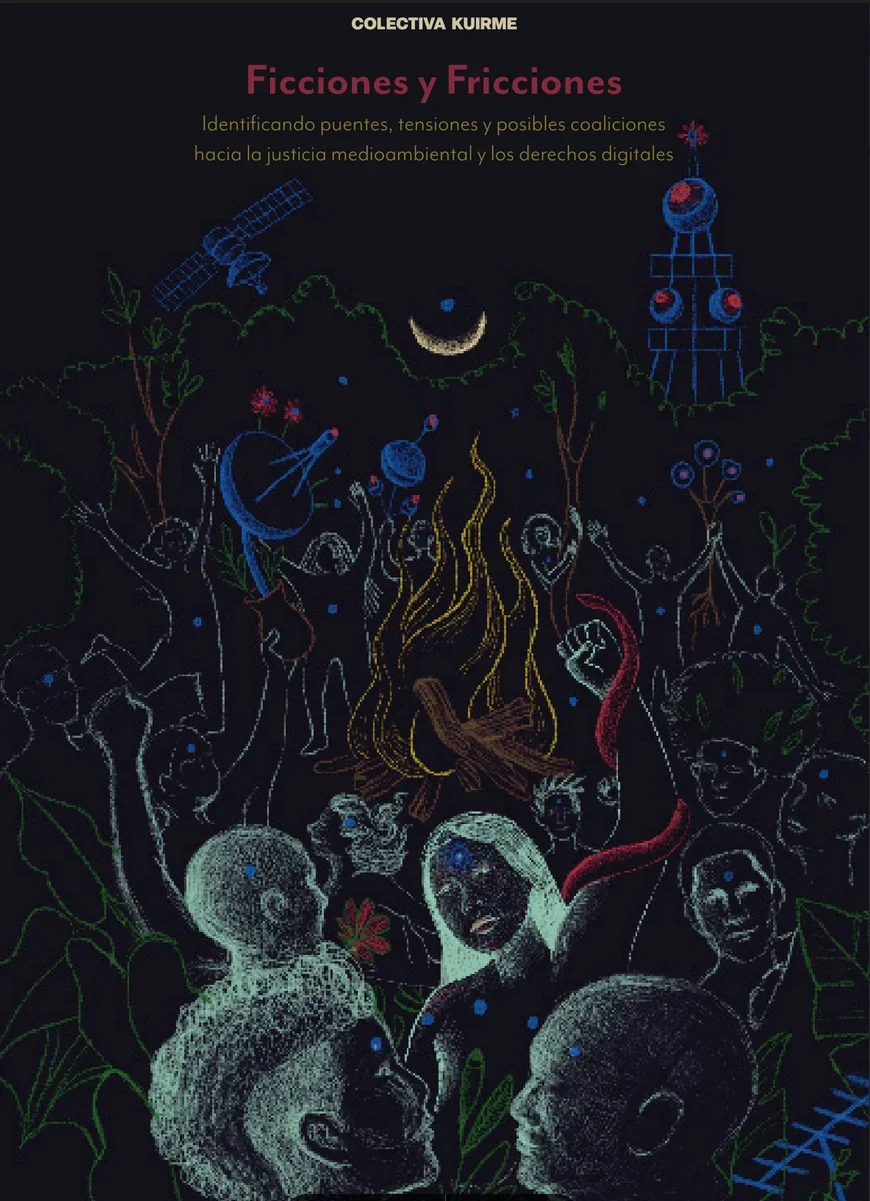
Cover of Kuirme publication
In 2023, Kuirme Collective interviewed practitioners in Brazil, Mexico, Germany and France, researching the current field at the intersection of digital rights and environmental justice. During this project, the group translated the initial report from English and created a new extended Spanish version titled “Ficciones & Fricciones”. Kuirme commissioned illustrations in order to facilitate an accessible reading of the findings, another form of translation. The conversations and illustrations were captured in an open-access online book launched in Fall 2025.
Through translation, Kuirme ensured that the communities they engaged with in Brazil and Mexico could benefit from the research about themselves and learn about the findings in their own language. Besides contributing to language justice, the collective developed a consultative approach rooted in community needs of the preferred format of presentation. With this, they show the importance of considering the distribution of resources and centering accessibility of knowledge as a key factor in building capacity in communities.
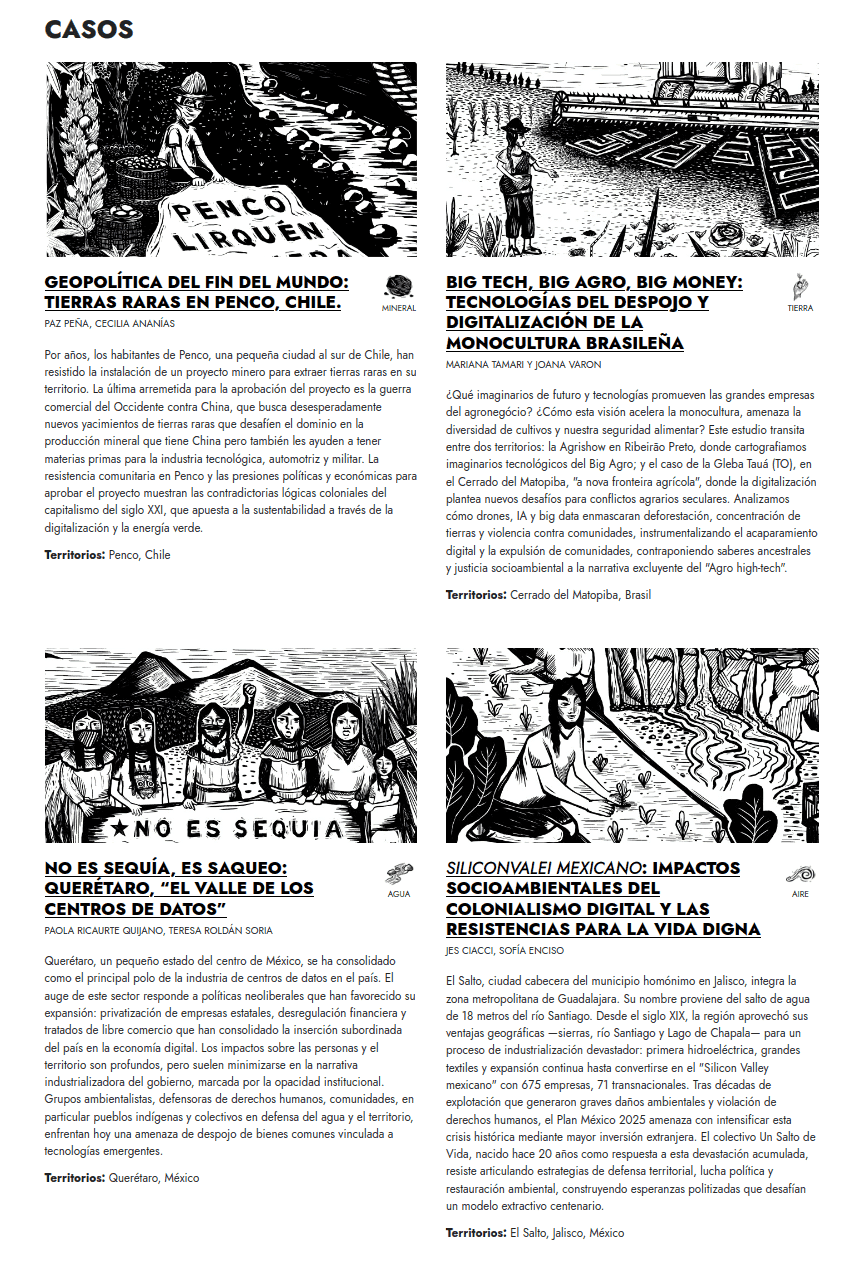
Snapshot from TRAMAS
The group “Floresta Digital” is formed of Coding Rights (Joana Varon y Mari Tamari), Instituto Latinoamericano de Terraformación (Paz Peña), Sursiendo (Jes Ciacci), Paola Ricaurte (Red Tierra Común y Red Feminista de Investigación en Inteligencia Artificial) and Loreto Bravo. The collective’s goal was to untangle the diverse socio-environmental impacts of digital technologies in Latin America. During this project, they formalised their coalition, produced a mapping of the socio-environmental conflicts of digital technology in Latin America, and identified 5 case studies on topics such as mineral extraction for digital devices and the techno-optimistic discourses that dominate their sale and social adoption. In Mexico City in August, they published TRAMAS – a website archiving the case studies – in Spanish, Portuguese and English at their launch event entitled “Technologies, Networks, Territories: Untangling the Socio-Environmental Impacts of Technologies in Latin America”.
Their project connected socio-environmental territorial struggles to the global production chain of the digital economy, garnering considerable interest from researchers in digital technologies and rights, both locally and internationally. The methodology shows that collective knowledge, ongoing dialogue, and regional experience are essential for understanding the complexities involved in this type of project.
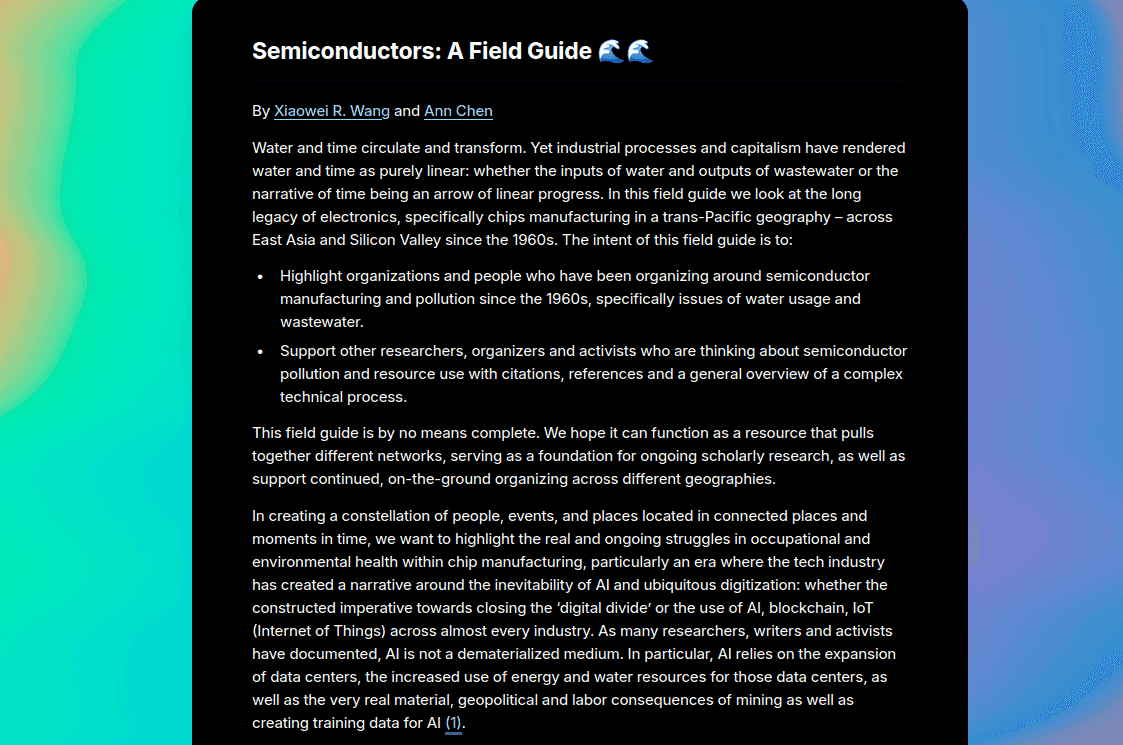
Snapshot from the field guide
Xiaowei Wang and Ann Chen developed a collective research project focused on the material and ongoing struggles in occupational and environmental health within chip manufacturing. Through site visits and interviews with organisers in Taiwan and Korea, the research looks at resource use and ecological impacts of semiconductor manufacturing over the past 60 years. The project also aimed to enable transnational solidarities among grassroots organisers. The research manifested in the publication “Semiconductors: A Field Guide" which functions as a resource that maps and connects networks, as a foundation for ongoing scholarly research, as well as continued support to on-the-ground organizing across different geographies.
The research was well received among researchers studying semiconductor environmental impacts, activists organizing around the CHIPS Act expansion in the US and international networks connecting tech worker solidarity movements. As it was circulated among networks, the research was also useful for organisers around semiconductor fabrication plants arriving in new communities.
“There is a need for sustained pressure from civil society groups on corporations and governments that prioritize development over community well-being, for greater environmental responsibility from the semiconductor industry.”
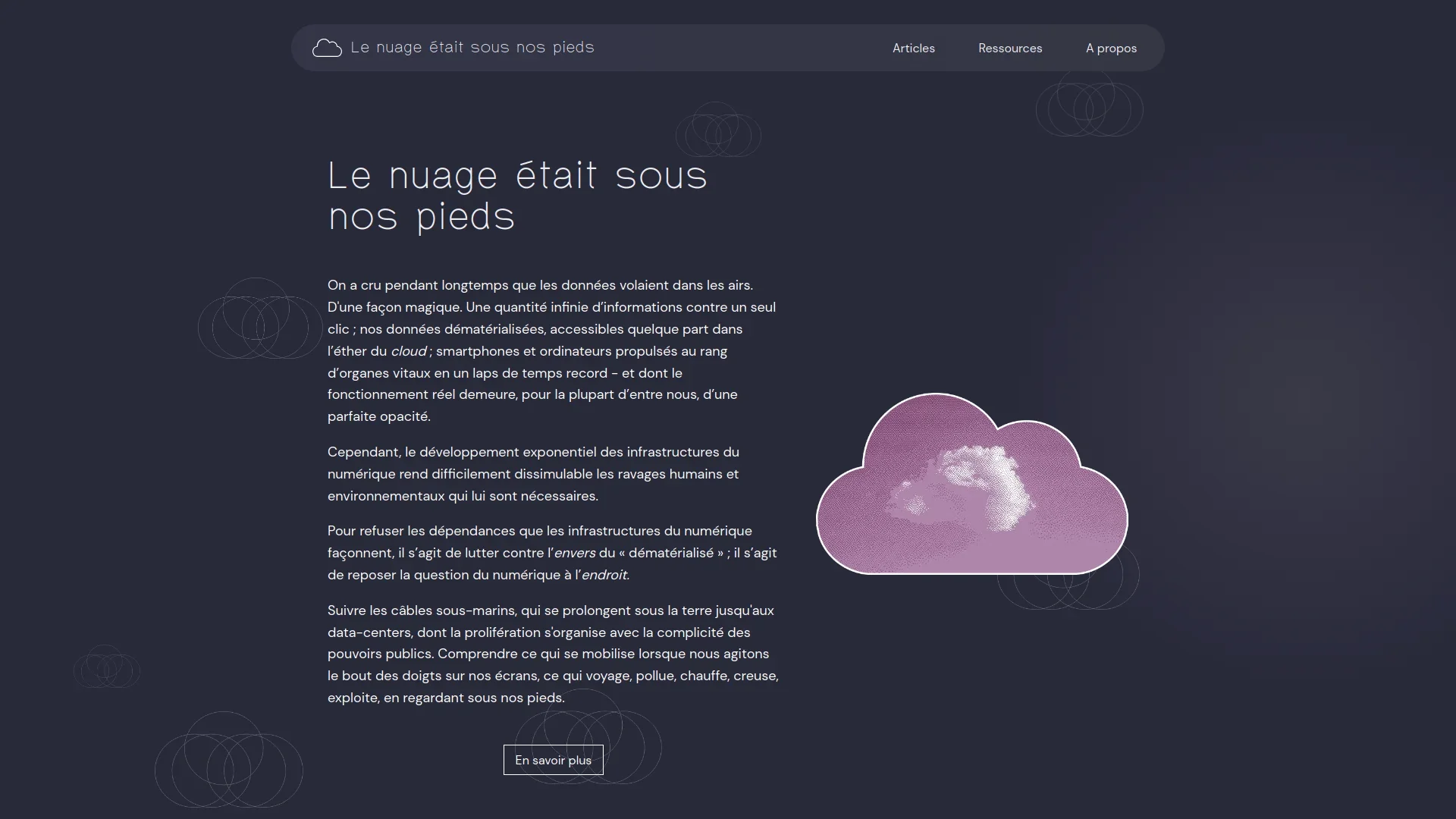
Snapshot from website
The collective Le nuage était sous nos pieds (The cloud was under our feet) produced two research-action investigations on digital infrastructures in Marseille and France as a continuation of their collective work on data center resistance in 2025, analysis in the lead up to the AI Action Summit France and their ongoing collaboration with the coalition Guerre à la Guerre (War against War).
The goal was to document the role of cloud infrastructures in the French military and articulate how Cloud infrastructures fit into imperialist strategies, and make that work publicly accessible for researchers and civil society. Their work concretely ties the expansion of tech infrastructure to expansion of securitisation in France and beyond.
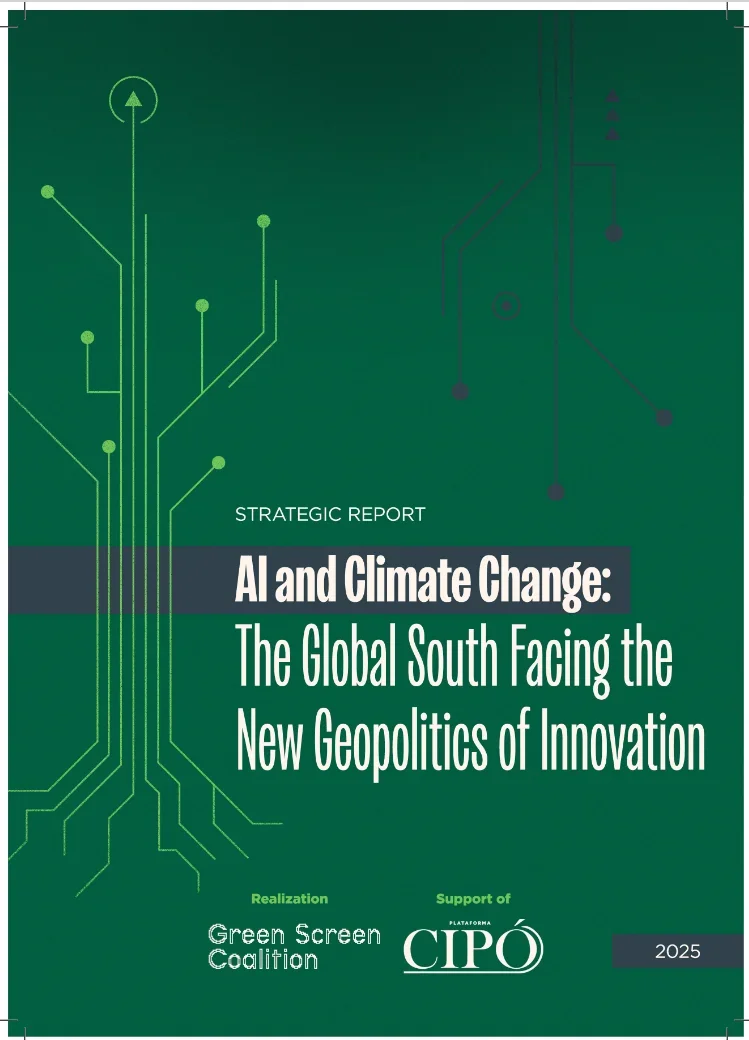
Cover of publication
As Strategic Advisor to the Green Screen Coalition, Lori has been guiding our understanding and approach towards engaging climate funders, strategic interventions at COP30, and analysis of how AI narratives for climate and infrastructures are expanding in Brazil and BRICs more broadly. In 2025, Lori produced the report – AI and Climate Change: The Global South Facing the New Geopolitics of Innovation – jointly launched by CIPÓ and Green Screen. The report articulates key connections between energy infrastructures, climate justice and purported AI solutions for the “energy transition”.
Their work argues for multilateral, pluriversal, and multisectoral approaches to digital infrastructure and industrial policy. Lori’s critique on the entanglement of many different social and political issues in Brazil is critical in a time where the technology industry lays the groundwork to be the saviors of COP30 in Belem, Brazil. In the leadup to COP, the report provided a powerful framing for those curious about the industrial dynamics in the region, and the ontological logic underpinning them.
Marie-Therese focused on building transnational solidarity around the impact of AI supply chains, through research, organising workshops, publishing photo essays and delivering stories of resistance to policy makers in different fora. The work involved hosting several workshops: an in-person workshop focusing on cobalt supply chains in the Congo and AI infrastructure expansion in Princeton, an online workshop on solidarity between Environmental Rights Foundation (Taiwan) and Friends of the Congo, and 2 workshops in Taipei on the intersections of tech and environmental justice. She carried out research on the semiconductor industry in Taiwan - including interviews and site visits with local individuals and groups and a visit to a semiconductor water treatment facility. She co-published a photo essay on research carried out in Taiwan and Chile forthcoming in the journal for Global Asias. Finally, she presented her work at the Institute for Advanced Study, Data for Black Lives, and COP30 in Brazil, and the G20 Summit in South Africa.
Participants gained to the workshops understanding of their own struggles in a transnational context, and built collective knowledge by sharing methods of resisting the environmental and labour impacts of AI infrastructure expansion.
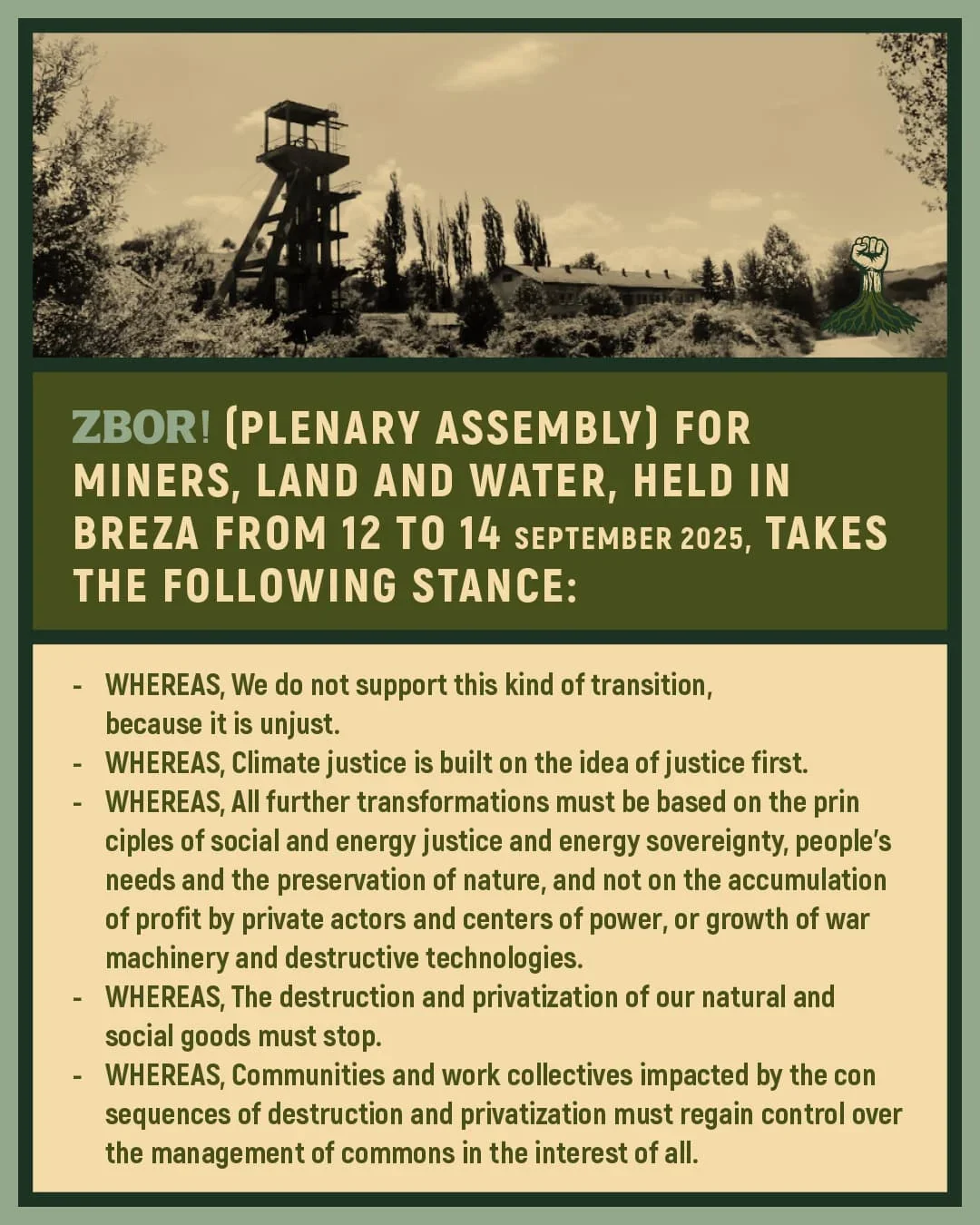
Demands from gathering
In September 2025, the collective ZBOR organized an in-person event in Breza – a small and vibrant mining town in the centre of Bosnia and Herzegovina. ZBOR stands for “Združeni Balkanski Otpor i Rad” or “United Balkans Resistance and Work”. The assembly brought a wide range of participants: miners, unionists, climate activists and environmental defenders from Bosnia and Herzegovina, neighboring countries and Western Europe.
The initiative was created in 2023 as a vehicle for organising against an imposed ‘green transition’ that profited the capitalist extractive economy. The assembly was able to find common ground and understanding of the so-called ‘just’ energy transition and its impact on the Balkans. Supporting grassroots organising and physical spaces for the articulation of shared analysis and demands is an essential component of social and environmental transformation.
MARIJÀN hosted a national forum on climate justice and digital rights, bringing together thirty young people, experts, and academics to collectively reflect on the intersections between gender, technology, and environmental justice. The project created a unique space for intergenerational and interdisciplinary dialogue on feminist approaches to climate justice and digital rights, a first of its kind in Haiti. Participants developed a deeper understanding of how climate change, digital access, and gender inequality intersect in their daily lives and in public policy.
As a result, the group published a white paper within a feminist agenda for climate action in Haiti and circulated it with policymakers - strengthening feminist advocacy on these issues. The paper outlined concrete policy recommendations for a more inclusive and gender-responsive approach to environmental challenges. Regional feminist organizations from the Dominican Republic and the Caribbean have also shown interest in replicating the model to foster cross-border collaboration.

Cover from report
ECOS partnered with Open Futures to produce the report “From innovation to overshoot: How data centre expansion risks derailing climate goals”. The report examines the impacts of data centers on current climate promises. It puts forward an analysis of the environmental impacts of data centres, explores solutions to mitigate these impacts, and recommends a set of possible EU policy responses.
In the process of articulating the position paper, ECOS was able to convene several meetings, build new partnerships, and raise awareness with other NGOs and progressive industry stakeholders about the importance of transparency around the energy intensity of digital services. Moreover, the group built its internal capacity by enhancing its employee’s understanding of the sustainability of data centers, and broader interrelation between digital rights and climate justice, a new thematic intersection for the organisation.
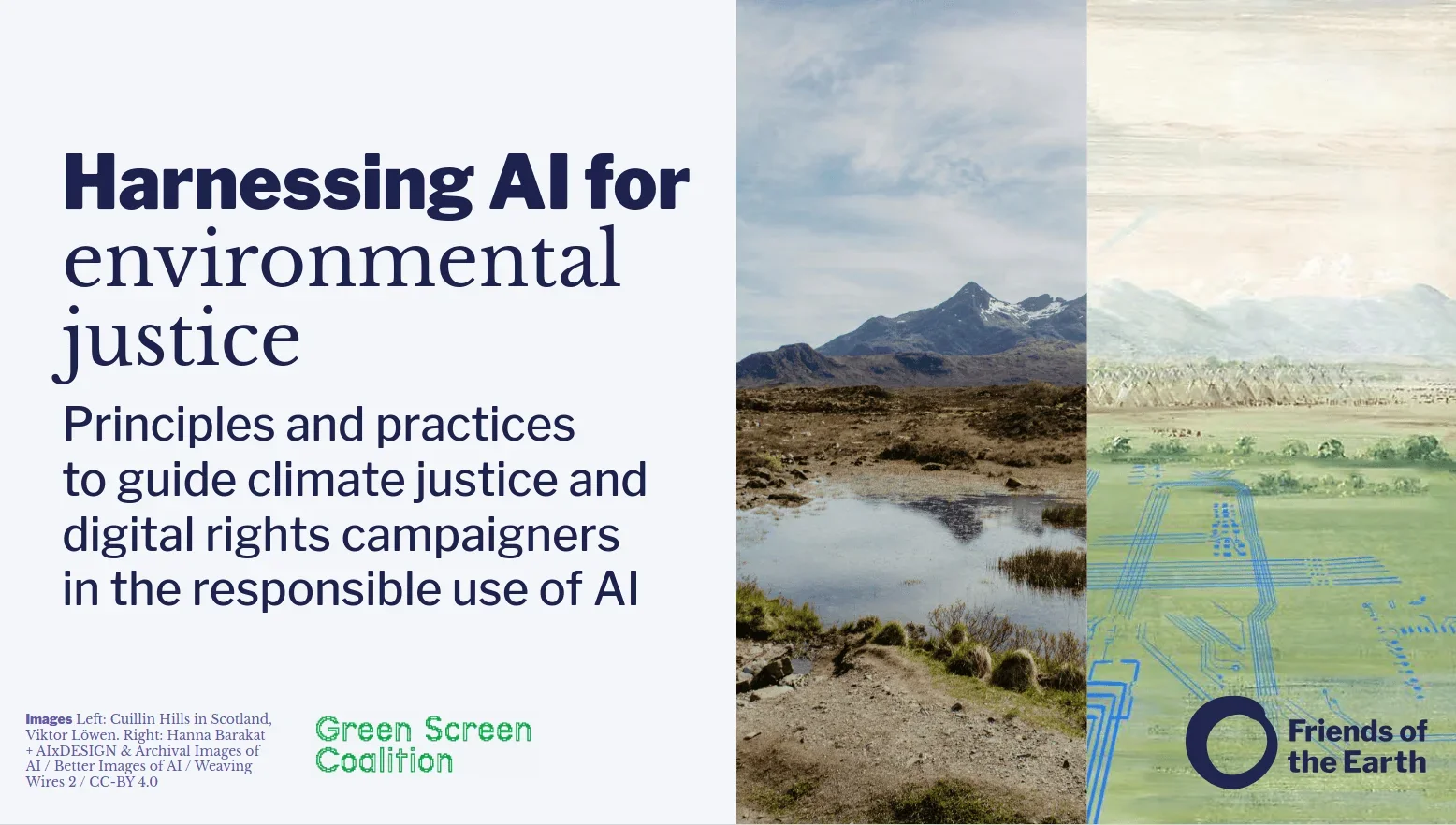
Cover from report
Friends of the Earth (FoE) set out to develop a coherent and practical set of policy demands around generative AI using large language models and its environmental impact. Following a collaborative exercise (desk research and roundtable) with environmental justice advocates and digital rights campaigners, FoE launched a report - Harnessing AI for Environmental Justice. This report shares principles and practical guidelines on how AI can be used responsibly, alongside recommendations for policy. In this paper, the group explored climate and energy, nature and environment and rights and justice and developed 7 principles for activists and campaigners to start their work from: curiosity, transparency, accountability, sustainability, community and intersectionality.
Through their work, FoE managed to go beyond the utopia-distopia dichotomy, and bridged two different fields: environmental justice activists and digital rights activists. While the title of the report seems to invite AI as a solution to environmental justice struggles, the report breaks down technical jargon and articulates the value (and lack of value) of different types of AI on offer. It is a helpful starting point for campaigners and those who are newer to digital justice conversations.
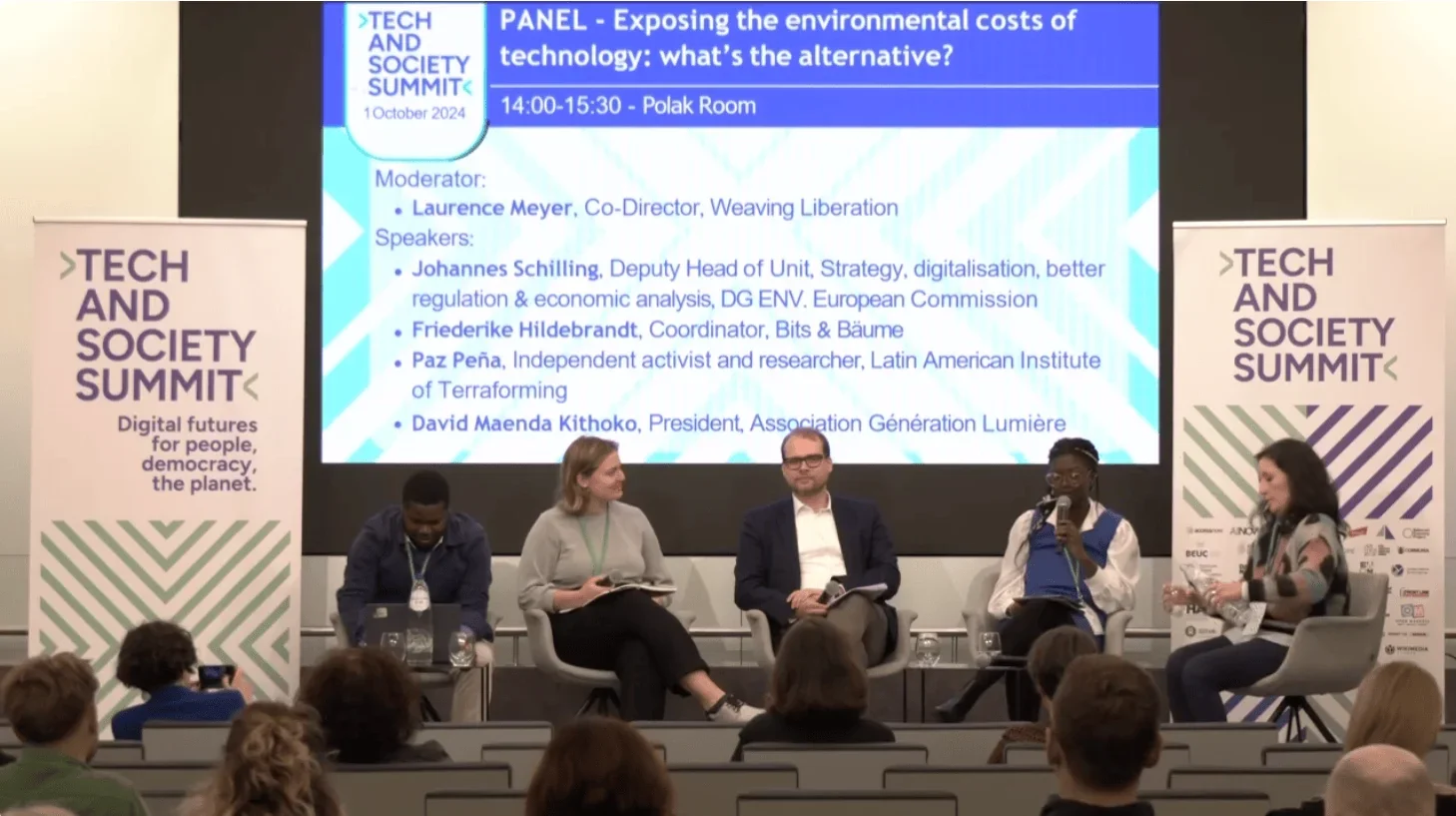
Tech and Society Summit
Green Screen supported the capacity building of the EDRi network, through coalition-building, convening, advocacy and awareness raising. EDRi created The Environmental Justice x Digital Rights Working Group (WG), bringing together 11 digital rights and 10 environment/ climate groups, with 6 coordination meetings being held during the project period. EDRi organised a narrative workshop, to collectively envision a community-centered, rights-focused tech field which is more intentional, democratic, and respectful of rights and planet. EDRi joined and amplified complementary efforts, such as the civil society statement “Within Bounds: Limiting AI’s Environmental Impact” around the AI Action Summit 2025, a LeMonde op-ed, and the End of 10 campaign promoting the right to repair.
EDRi also widened its partnerships, and established working relations with environmental NGOs such as the EU Raw Materials Coalition and its members (run by the European Environmental Bureau), the Attecking group focused on data centers, ECOS and Global Witness. Their continued work on the intersection exemplifies how the digital rights field is increasingcontent/en/blog/grantee-showcase.mdly aware that not only are our struggles interconnected, but actually the digital space is a massive driver of environmental harms.
GFF homepage
Together with environmental researchers André Ulrich and Maike Gossen, GFF developed a comprehensive data access application for accessing data on environmental harms caused by Zalando’s return policies and the impact of ecolables on consumer choices. The application addresses underlying legal questions around whether environmental harms can be considered as systemic risks according to the Digital Services Act (DSA). Data access requests under the DSA require a complex application in which the researchers must provide a legal analysis linking their research to systemic risks caused by platforms and connection to data security issues.
In effect, GFF has commissioned and revised a comprehensive data protection and data security concept that can also serve as a blueprint for other applicants. Starting October 2025, others can use this blueprint to file data access requests with the Digital Services Coordinators (DSCs). During the project period, GFF actively engaged with the community of environmental researchers in Germany and with the international research community working on data access. Their work also illuminates the time needed to request data, build a case and see results.
As an accompaniment to collective work surrounding the AI Action Summit India, we commissioned Digital Futures Lab to develop a high level analysis on data center buildout in India and its accompanying AI infrastructure. The work outlines paths for civil society and international network engagement during and beyond the summit, illuminating national and international industry and governmental narratives on sustainable AI, economic promises and resource requirements of large scale data center development.
While the tech industry employs similar tactics across the world in order to expand their reach, each country has its own cultural and political dynamics that influence what the agenda for and against the infrastructure looks like. The public facing work is forthcoming in January 2026.
We are just getting started. The incredible work from these groups connects to the work of so many more around the world. We will share more on our grantmaking and field-building approach in the new year. For those interested in resourcing the work of these amazing actors, please get in touch with us or contact the organisations directly.

We’re two years after the kickoff of the Green Screen Catalyst Fund—an offering that resulted from several years of …
launch
The AI Hoax report The big tech industry’ claim about the climate benefits of artificial intelligence (AI) …
launch
We are happy to share this strategic report–AI and Climate Change: The Global South Facing the New Geopolitics of …
launch publication